

This is Rambert Review 4*
This is Rambert is a bold, youthfuil triple bill marking the centenary of the UK’s oldest dance company
This artice was first published on London Unattached
You can celebrate a landmark birthday – a centenary, in the case of Rambert, the UK’s foremost contemporary dance company – in either of two ways. You can look back at the key moments of a long and illustrious life, to outline “how we got here”.
Or you can opt to say, this is where we are, and this where we’re going. We’re looking to the future, not the past. As the tagline in the printed programme for This is Rambert, its anniversary show, has it, “We’re 100 and we’re just getting started”.
It’s not as though Rambert, in its look-ahead current incarnation, is entirely forsaking its past: the printed programme for This is Rambert, which opened at Sadler’s Wells prior to an international tour, contains a detailed account of its history. The first ballet company in the UK, founded by the formidable Polish emigrée Marie Rambert in 1926, over the years it has shown a remarkable ability to grow and shapeshift to adapt to, and reflect, the times it lives through. In the process, Rambert has nurtured influential names in ballet and contemporary dance, from a young Frederick Ashton through Anthony Tudor, Richard Alston, Christopher Bruce and Mark Baldwin, to mention but a few.
All left their imprint on Rambert, and Benoit Swan Pouffer, the company’s artistic director for the past six years, is determined to leave his, too. In This is Rambert Pouffer assembled a triple bill of works by international choreographers working at the cutting edge of contemporary dance. The programme is loud, brash and exuberant, showcases the tremendous talent of Rambert’s 18 multi-national dancers, and I for one enjoyed a lot.
It kicked off with a première: In Crimson, director choreographers Bobbi Jane Smith and Or Schraiber’s first work to be performed in the UK.
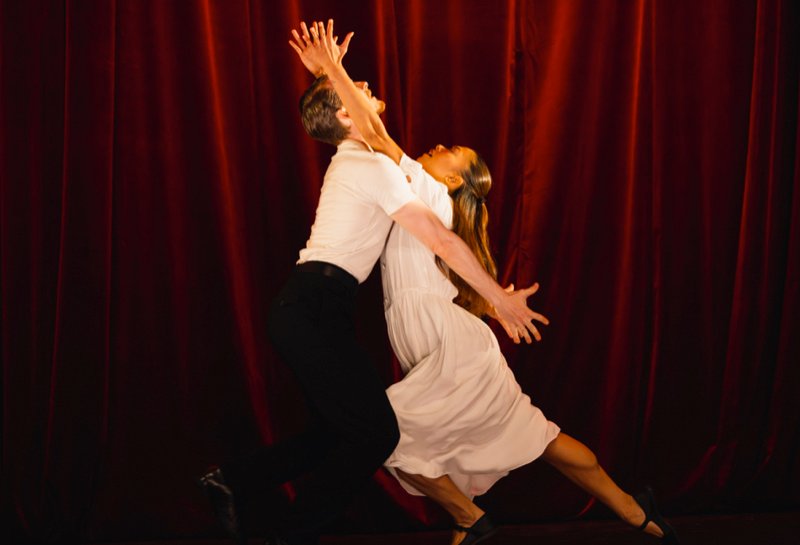
Danced on a narrow corridor in front of red stage curtains, an upright piano stage left providing live music, In Crimson plays on the clash between what’s seen and what’s hidden, in front or behind the curtains. One by one, later in groups, dancers emerge from the wings. Vigorous encounters prove fleeting; everything is frenzied until an old recording of tenor Enrico Caruso, establishes a more meditative mood. I found it intriguing and very digestible.
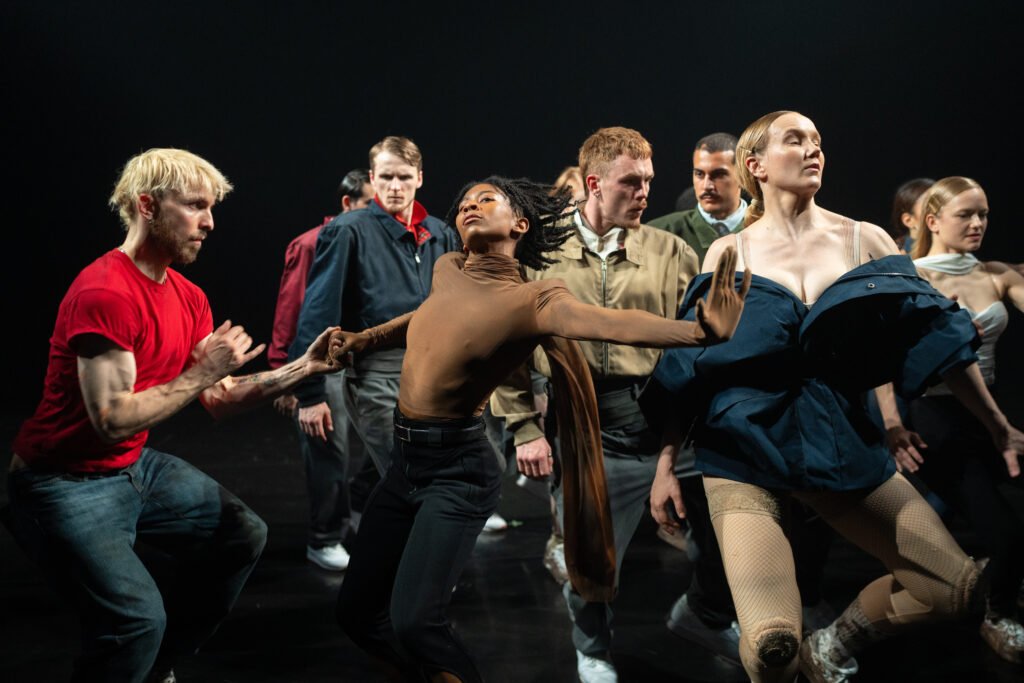
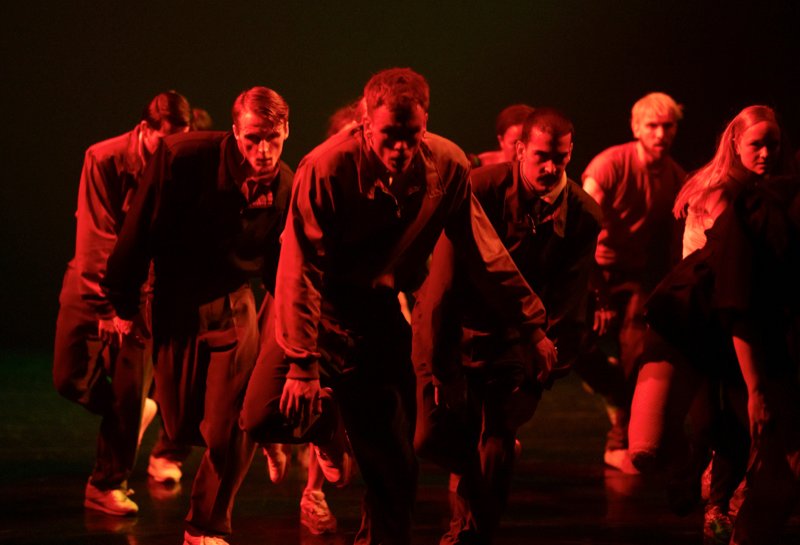
Hop(e)Storm created by Rambert in conjunction with the French collective (LA)HORDE, premièred at the Southbank last year. Drawing from the energy, rhythms and spirit of Lindy Hop, it starts with two lines of dancers facing each other across the stage. One by one, women rush across and throw themselves at men. Following that unsettling prologue, the 12 dancers join up, first doing a spot of line dancing, then inhabiting a 1940s dance hall, to dance a full blown bout of Lindy Hop (a swing instructor, Simon Selmon, is credited). It’s lit by Eric Wurtz with capricious, ever-changing nightclub colours.

The raw energy of this piece, animated by Pierre Aviat’s assertive, pounding musical score, is contagious and the dancers’ sheer joy and togetherness make for a thrilling half-hour.
The final piece in the programme was perhaps the most sophisticated. Commissioned by Rambert from the Dutch choreographer Emma Evelein, Gallery of Consequence uses an airport setting as a metaphor for life itself.
The curtain goes up on a familiar scene: against the background of a departures board, and a row of uncomfortable plastic chairs, travellers pulling cases on wheels make their way to the check-in desks on either side, lulled by a fuzzy sound score, that reflects the numbing atmosphere of airports.
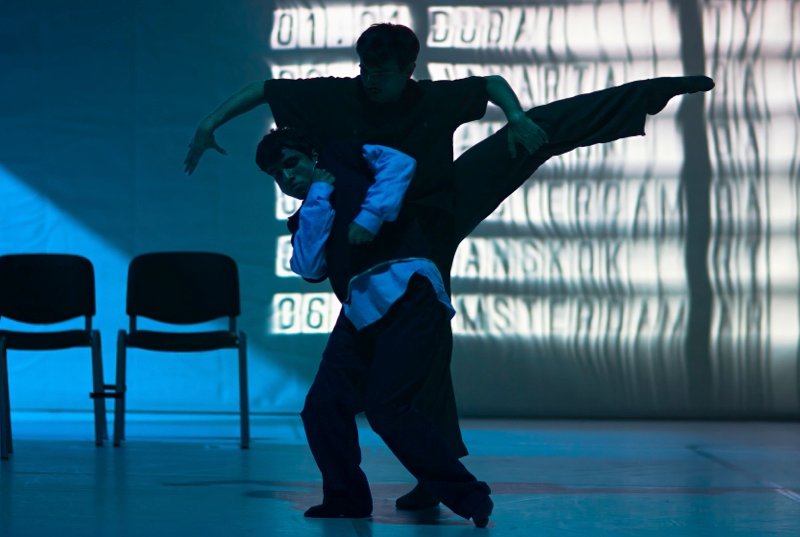
At intervals, though, reality gives way to nightmarish unreality, as departure board directions, such as ‘boarding”, dissolve to become instead words like “scared” and “alone”, and the passengers turn on each other, their inner fears taking over.
Finally they form an orderly queue to board, but all flights are shown as departed, missed and cancelled. And so you’re left wondering if it’s really a plane they are queueing to board or something more final.
This is Rambert is youthful and very much de nos jours. It’ll be interesting to see where the company goes from here.
© Teresa Guerreiro
(Banner Image: Rambert in Hop(e)Storm by (LA)HORDE. Photo: Hugo Glendinning)
This is Rambert is at Sadler’s Wells 11 – 13 June 2026 then touring